
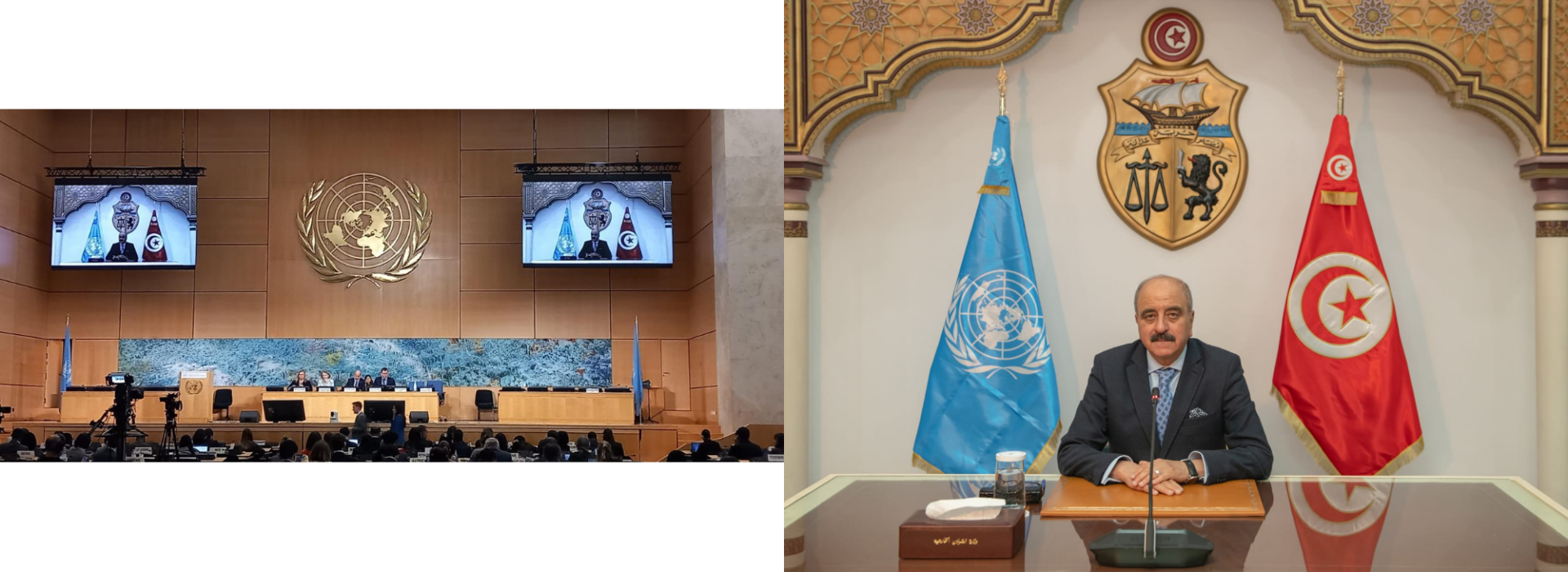
On February 23, 2026, Tunisia’s Minister of Foreign Affairs, Migration and Tunisians Abroad, Mohamed Ali Nafti, delivered the country’s statement by videoconference during the High-Level Segment of the 61st session of the United Nations Human Rights Council in Geneva.
Tunisia reaffirmed its strong commitment to promoting and protecting all human rights — civil, political, economic, social, cultural, and environmental — without selectivity and in full respect of state sovereignty. The minister stressed Tunisia’s continued cooperation with the Human Rights Council and its mechanisms, noting that the country is party to most international human rights treaties and hosts an Office of the UN High Commissioner for Human Rights.
Highlighting Tunisia’s historical legacy, the statement recalled the country’s longstanding support for national liberation movements, its early abolition of slavery in the 19th century, and its commitment to freedom and sovereignty as it approaches the 70th anniversary of independence. Tunisia continues to strengthen its national human rights system, focusing on the rule of law, justice, anti-corruption efforts, and the protection of human dignity.
The government also emphasized ongoing reforms launched on July 25, 2021, aimed at enhancing democratic governance and expanding citizen participation at all levels. Social justice and equal opportunity were identified as key national priorities, alongside legislative efforts to combat precarious employment.
Addressing migration, Tunisia called for shared international responsibility in tackling irregular migration and human trafficking. The country reaffirmed its commitment to protecting migrants while facilitating voluntary, safe, and dignified returns in cooperation with the International Organization for Migration and partner states. Tunisia also urged a comprehensive approach that addresses the root causes of migration through balanced partnerships among countries of origin, transit, and destination.
Finally, Tunisia expressed concern over grave human rights violations worldwide, particularly the situation of the Palestinian people in Gaza. The statement called for accountability for war crimes, rejected forced displacement, and reaffirmed Tunisia’s support for the Palestinian people’s right to self-determination and the establishment of an independent state with East Jerusalem as its capital.
